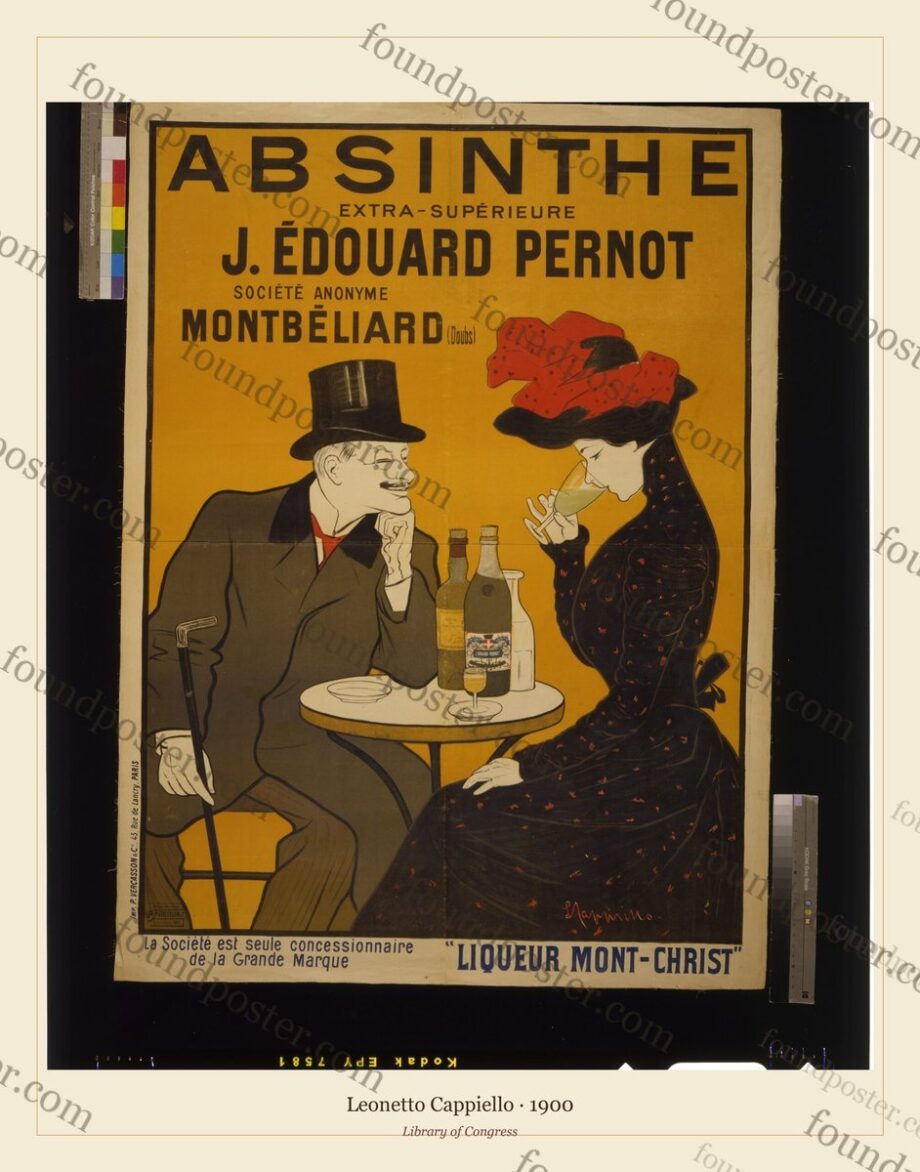
TL;DR — Leonetto Cappiello’s 1900 poster for Absinthe J. Édouard Pernot is one of the founding images of modern advertising. Where the reigning master, Jules Chéret, filled his posters with swirling crowds, Cappiello isolated a single luminous figure against a near-black ground — an image the eye grabs in a second from a moving carriage. This is the story of the Italian caricaturist who worked out, on a Paris hoarding, how a brand becomes a picture you cannot forget.
By Found Poster · Published July 2026
The poster that changed advertising
The Pernot poster does something that looks obvious now and was radical in 1900: it gives you one thing to look at. A single bright figure leaps out of a dark background holding the product aloft; there is no street scene, no crowd, no anecdote — just a character and a name, locked together so tightly that seeing one recalls the other.
That isolation was the invention. On a boulevard papered with busy, pretty posters, Cappiello’s stark figure-on-black stopped the eye precisely because it refused to compete on detail. It is widely taken as the hinge between the decorative nineteenth-century poster and the brand-driven advertising of the twentieth.
From caricature to poster
Leonetto Cappiello (1875–1942) was born in Livorno, on the Tuscan coast, and arrived in Paris in 1898 as a young caricaturist, drawing celebrity likenesses for satirical papers such as Le Rire and Le Figaro. That training mattered: a caricaturist’s job is to reduce a person to a few unmistakable lines, and Cappiello carried that reduction straight into advertising.
The Pernot commission in 1900 was among his first major posters, and it set the pattern for everything after. Over the next four decades he produced more than a thousand poster designs and became the most sought-after advertising artist in France.
The method: one figure on black
Cappiello’s formula — a single invented character, often strange or comic, glowing against a dark field — became known as his signature and was widely imitated. The dark ground was a deliberate device: it made the bright figure jump forward and gave the poster a single focal point readable at speed and at distance.
Set against Chéret’s rococo abundance, the economy is the whole point. Chéret sold an atmosphere; Cappiello sold a mnemonic. Every modern ‘brand character,’ from liqueur devils to tyre men, descends from this idea.
The absinthe world
Absinthe was the defining drink of Belle Époque Paris, and posters like this one were how brands fought for a share of it. That gives the image a double life on a modern cocktail-bar wall: it is authentic period décor from the golden age of the apéritif, and, at the same time, a direct ancestor of the drinks marketing hanging in the same room a century later.
Father of modern advertising
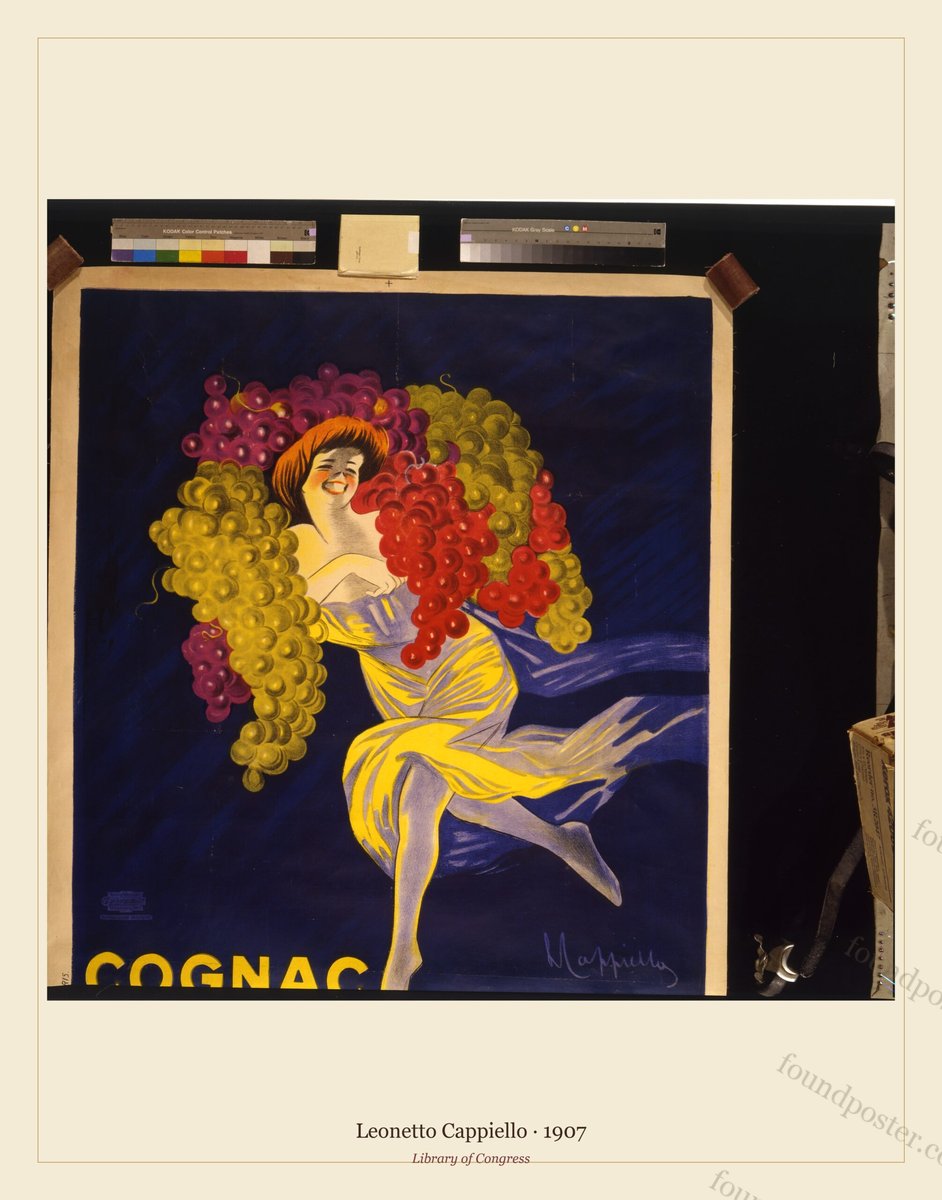
Cappiello’s later posters — the fire-breathing clown for Le Thermogène (1909), the campaigns for Cinzano and Campari — made the figure-on-black method famous across Europe. He is routinely called the father of modern advertising, and the claim is fair: he was the first to treat a poster not as a decorated scene but as a brand reduced to a single unforgettable character. In a cocktail bar or speakeasy, the Pernot poster still does the job it was engineered for — it reads instantly across a dim room.
Cappiello’s apéritif and spirits posters are catalogued individually in our archive, restored for printing. Browse Cappiello →
Frequently asked questions
Who was Leonetto Cappiello?
An Italian-born caricaturist (1875–1942) who became the leading advertising-poster artist in France, producing more than a thousand designs. He is widely called the father of modern advertising.
Why is the 1900 Pernot poster important?
It is an early, defining example of his ‘one figure on a dark ground’ method — isolating a single memorable character instead of a busy scene — which reset how brands were advertised.
How is Cappiello different from Chéret?
Chéret filled posters with swirling crowds and sold an atmosphere; Cappiello reduced a poster to one arresting figure and sold instant brand recall. The two mark the shift from decorative to modern advertising.
Is absinthe imagery suitable for a bar?
Yes — it is celebrated period décor from the apéritif’s Belle Époque heyday and a natural conversation piece in a cocktail setting.
Further reading
- Who was Leonetto Cappiello? — a fuller survey (scheduled in this series)
- Cappiello and the birth of modern advertising (scheduled in this series)
- Absinthe and apéritif posters — the drink and its images (scheduled in this series)
- Jack Rennert, the standard catalogue of Cappiello’s posters (Poster Art Library)
- Alain Weill, The Poster: A Worldwide Survey and History (G.K. Hall, 1985)
Found Poster restores Belle Époque and Art Nouveau posters from museum archives into archival-quality files you print yourself. Browse the archive · How to print & frame.