
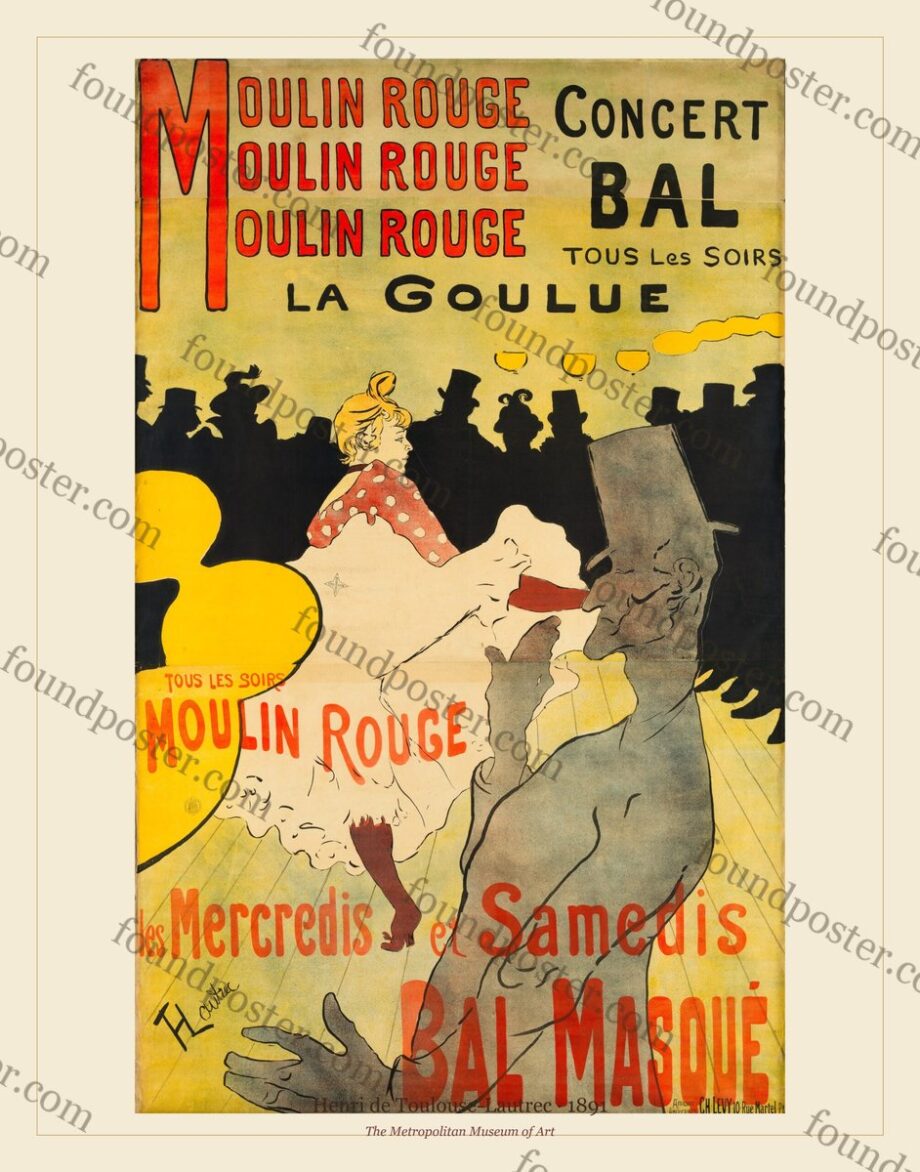
TL;DR — In the autumn of 1891 the Moulin Rouge commissioned a little-known 26-year-old aristocrat, Henri de Toulouse-Lautrec, to design a poster for its star dancer, La Goulue. His first lithographic poster went up on the walls of Paris that December and made him famous within days. Borrowing the flat colour, hard outlines and empty space of Japanese woodblock prints, it turned a piece of commercial advertising into fine art — and set the visual template for the entire Belle Époque poster. This is the story of the dance hall, the dancer, and the print that changed graphic design.
By Found Poster · Published June 2026
The Moulin Rouge: Montmartre’s electric palace
The Moulin Rouge opened on 6 October 1889 at the foot of Montmartre, on the Boulevard de Clichy, in the same season the Eiffel Tower was drawing crowds to the Exposition Universelle across the city. Its owners, Charles Zidler and Joseph Oller — who already ran the Jardin de Paris and the Hippodrome — built it as a purpose-made machine for spectacle: a mock red windmill on the roof, a garden with a giant stucco elephant, and, most startling of all, electric light at a moment when most of Paris still ran on gas.
What it sold was the cancan — or more precisely the chahut, a fast, high-kicking, deliberately indecent dance performed by professional women to a live orchestra. The Moulin Rouge put top hats and labourers on the same floor, and that social friction was the point. By 1891 it was the most talked-about entertainment in Europe’s entertainment capital, and it needed posters to keep the seats full.
La Goulue and Valentin le Désossé
La Goulue — ‘the Glutton’ — was the stage name of Louise Weber (1866–1929), an Alsatian laundress’s daughter who had danced her way to the top of the Paris cabaret world. The nickname came from her habit of draining patrons’ glasses as she passed their tables. By 1891 she was the highest-paid performer at the Moulin Rouge and one of the most recognised women in France.
Her partner in the poster is Valentin le Désossé — ‘the Boneless One’ — the stage name of Jacques Renaudin, a wine merchant’s son who danced as an unpaid amateur for the love of it, prized for his rubber-limbed, deadpan contortions. Lautrec places him in the foreground as a tall grey silhouette, framing La Goulue’s white petticoat like a proscenium arch.
La Goulue’s story did not end well, and Lautrec followed it. In 1895 she left the Moulin Rouge to run her own fairground booth and commissioned Lautrec to paint its side panels (now in the Musée d’Orsay). The booth failed; she grew heavy, drifted through circus and wrestling acts, and died poor and largely forgotten in 1929. The poster outlived her fame by a century.
The commission and the lithograph
Until 1891 the Moulin Rouge had advertised with posters by Jules Chéret, the reigning master of the form, whose swirling crowds of rosy dancers defined the genre. When Zidler handed the next commission to Lautrec — then barely known outside Montmartre — it was a gamble on a younger, stranger talent.
Lautrec answered with a colour lithograph nearly 1.7 metres tall, printed from several stones. He built the image with flat zones of colour and a technique called crachis — literally ‘spitting’ — in which ink was flicked through a screen to lay down a fine spatter of tone, visible in the yellow halo of electric globes above the dancers. The run was roughly three thousand copies, and they were pasted across Paris in December 1891.
A new visual language: japonisme and flat colour
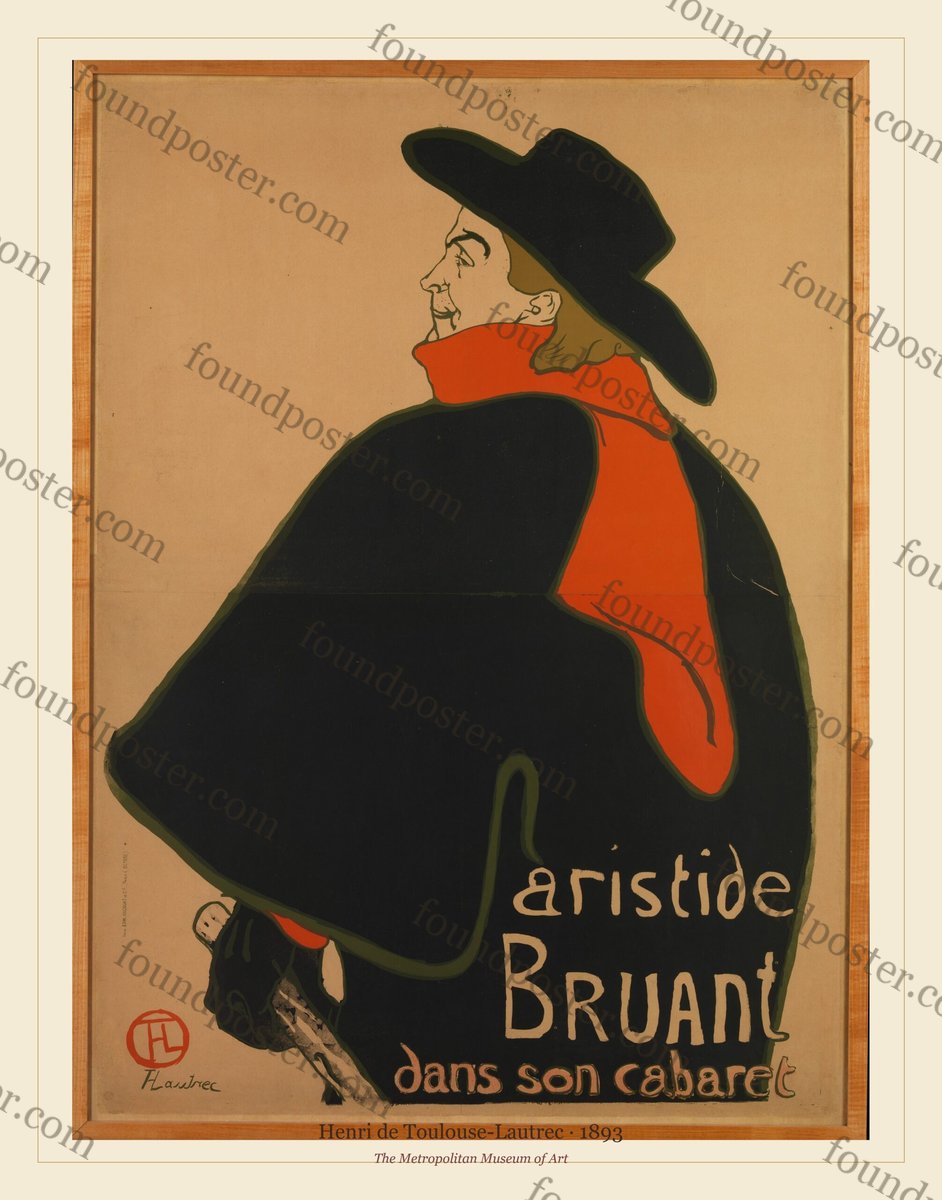
What made the poster revolutionary was its grammar, not its subject. Lautrec had absorbed the Japanese ukiyo-e woodblock prints then flooding Paris dealers, and he took from them everything a busy street demanded: large flat areas of unmodelled colour, hard confident outlines, bold empty space, and figures cropped by the edge of the sheet as if caught mid-movement.
Set against Chéret’s decorative swirl, the economy was startling. The black frieze of spectators becomes one flat shape; Valentin is a grey ghost; La Goulue’s froth of white underskirt is the single bright event in the middle of the sheet. A viewer crossing the boulevard could read the whole thing in a second — which is exactly what a poster on a wall has to do.
Every poster artist of the next two decades was, in some sense, answering this image. Its flattening and cropping fed directly into the work of Pierre Bonnard and the Nabis, into Art Nouveau, and ultimately into twentieth-century graphic design. Historians of the medium routinely date the arrival of the poster as a serious art form to this sheet.
Afterlife: from hoarding to museum
The poster was made to be destroyed. Pasted to a wall or a Morris column, rained on, torn, and papered over within weeks, the great majority of the 1891 print run did not survive. The copies that did — many rescued by early collectors who understood what they were watching — are now among the most sought-after posters in the world.
Impressions of Moulin Rouge: La Goulue are held by the Museum of Modern Art in New York, the Bibliothèque nationale de France, the Victoria and Albert Museum in London, and the Musée Toulouse-Lautrec in Albi, the artist’s birthplace. First-state original impressions, when they appear at auction, sell into the six figures. The image has become one of the defining visual shorthands for the Belle Époque, reproduced on everything from scholarly book jackets to café walls.
That afterlife is also why the poster still does its job in a room. It carries the whole idea of 1890s Paris nightlife in a single glance — which is what Zidler paid Lautrec for in the first place.
Moulin Rouge: La Goulue and Lautrec’s other Montmartre posters are catalogued individually in our archive, restored from high-resolution scans for printing at home or in a shop. Browse Toulouse-Lautrec →
Frequently asked questions
Who was La Goulue?
Louise Weber (1866–1929), the highest-paid cancan dancer at the Moulin Rouge, whose stage name meant ‘the Glutton.’ She was the subject of Lautrec’s 1891 poster and later ran a fairground booth whose panels he painted; she died in poverty in 1929.
What made the 1891 Moulin Rouge poster revolutionary?
Its visual language. Lautrec borrowed the flat colour, hard outlines and cropped composition of Japanese woodblock prints and applied them to a commercial advertisement, replacing the decorative crowds of earlier posters with a single readable image. It is widely credited as the point at which the poster became a serious art form.
What is the crachis technique?
Crachis (French for ‘spitting’) is a lithographic method in which ink is flicked or sprayed through a screen to create a fine spatter of tone rather than a solid or hand-drawn area. Lautrec used it for the soft halo of electric light above the dancers.
Do original 1891 copies survive, and are they valuable?
Very few of the roughly 3,000 originals survive, because posters were consumed and discarded. Surviving first-state impressions are held by major museums and sell for six figures at auction. What we offer is a restored digital file for printing, not an original impression.
Further reading
- Who was Toulouse-Lautrec? — a survey of the artist (scheduled in this series)
- The Moulin Rouge and the cabaret poster — the wider genre (scheduled in this series)
- Julia Frey, Toulouse-Lautrec: A Life (Viking, 1994)
- Phillip Dennis Cate & Nancy Finlay, The Color Revolution: Color Lithography in France, 1890–1900 (Zimmerli / Rutgers, 1978)
- Ruth E. Iskin, The Poster: Art, Advertising, Design, and Collecting, 1860s–1900s (Dartmouth, 2014)
Found Poster restores Belle Époque and Art Nouveau posters from museum archives into archival-quality files you print yourself. Browse the archive · How to print & frame.