
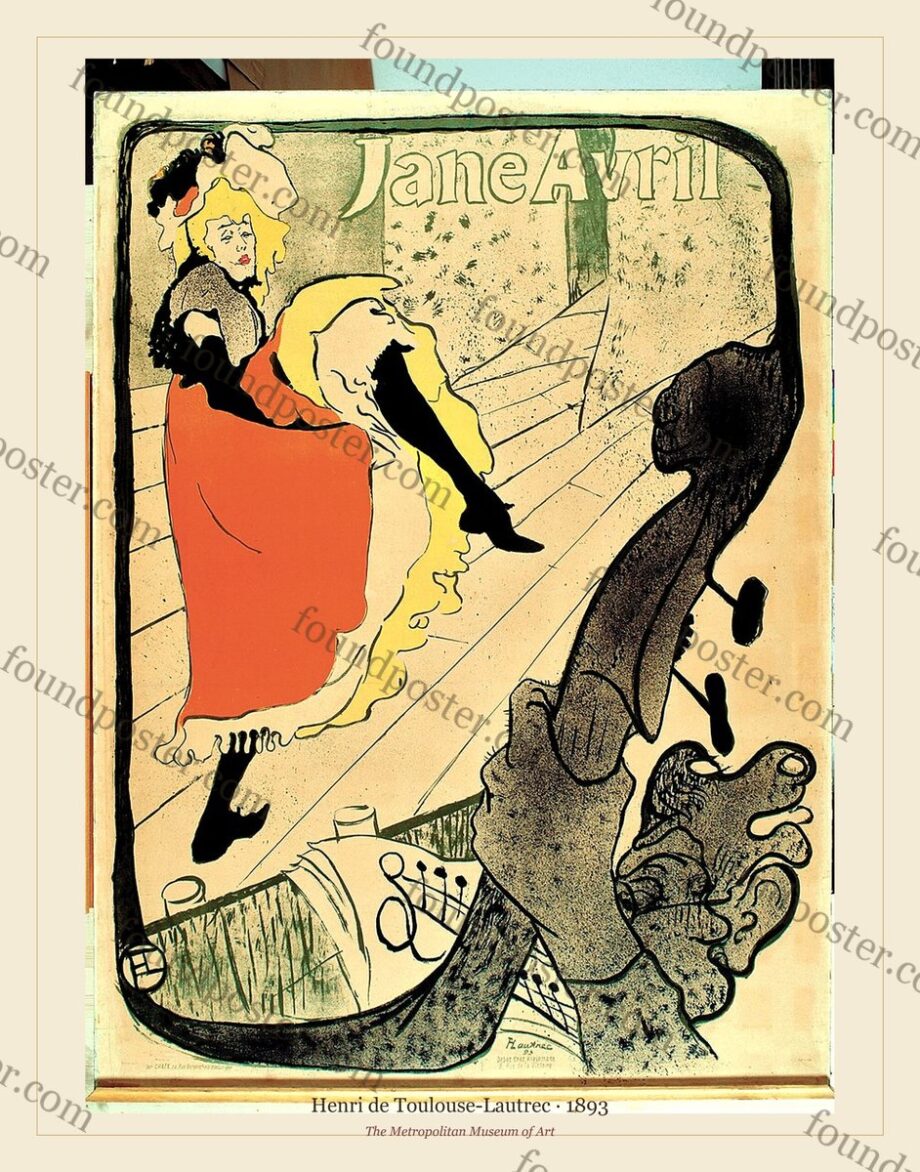
TL;DR — Toulouse-Lautrec’s 1893 poster of Jane Avril is the counterpart to his Moulin Rouge: where La Goulue was raw energy, Jane Avril is nervous elegance. Avril was Lautrec’s friend and favourite subject — a refined, melancholy dancer he portrayed again and again. This deep dive looks at the dancer, the friendship, and one of the most sensitive images in all of poster art.
By Found Poster · Published September 2026
Two dancers, two temperaments
If La Goulue was the Moulin Rouge’s brash star, Jane Avril was its refined one. Contemporaries called her elegant, nervous, almost aristocratic in her restraint — a dancer who seemed to perform for herself as much as the crowd. Lautrec’s posters of her carry that inwardness: the colour is subtler, the pose more self-contained, the mood closer to melancholy than to spectacle.
Jane Avril
Jane Avril (1868–1943), born Jeanne Beaudon, had a hard early life and spent time as a young patient at the Salpêtrière hospital in Paris before finding her way to dancing. She became a star at the Moulin Rouge and the Jardin de Paris in the early 1890s, known by the nickname ‘La Mélinite’ after a powerful explosive — a joke about the contained force of her dancing.
She was intelligent and well-read, moved in artistic circles, and unlike many performers of the era she lived to old age. Her memoirs are one of the more valuable first-hand records of the Montmartre world.
Lautrec’s favourite subject
Avril and Lautrec were genuine friends, and he portrayed her more than any other performer — on posters, in prints, in paintings, on the cover of the theatre programme for the Théâtre Libre. She trusted him to show her as she was, and that trust produced some of his most sensitive work.

Why it still moves people
The Jane Avril posters endure because they are portraits, not advertisements that happen to show a person. Lautrec gives her dignity and interiority — a real, complicated woman rather than a type — and that psychological truth is rare in commercial art of any era. On a wall, a Jane Avril brings the quieter, more human side of Montmartre: perfect for a cocktail bar or bistro that wants elegance and depth rather than noise.
Lautrec’s portraits of Jane Avril and the other stars of Montmartre are catalogued individually in our archive, restored for printing. Browse Toulouse-Lautrec →
Frequently asked questions
Who was Jane Avril?
Jane Avril (1868–1943), a celebrated, elegant dancer at the Moulin Rouge and Jardin de Paris, nicknamed ‘La Mélinite,’ and Toulouse-Lautrec’s close friend and most frequent subject.
How is she different from La Goulue?
La Goulue was brash, raw energy; Jane Avril was refined, nervous and melancholy. Lautrec’s posters of the two capture opposite temperaments of the same Montmartre world.
Why did Lautrec paint her so often?
They were genuine friends; she trusted him to portray her honestly, and that trust produced some of his most sensitive, psychologically rich images.
Further reading
- Lautrec’s Moulin Rouge: La Goulue — the brash counterpart
- The Moulin Rouge and the cabaret poster (scheduled in this series)
- Julia Frey, Toulouse-Lautrec: A Life (Viking, 1994)
- Jane Avril, Mes Mémoires (memoir; various editions)
Found Poster restores Belle Époque and Art Nouveau posters from museum archives into archival-quality files you print yourself. Browse the archive · How to print & frame.