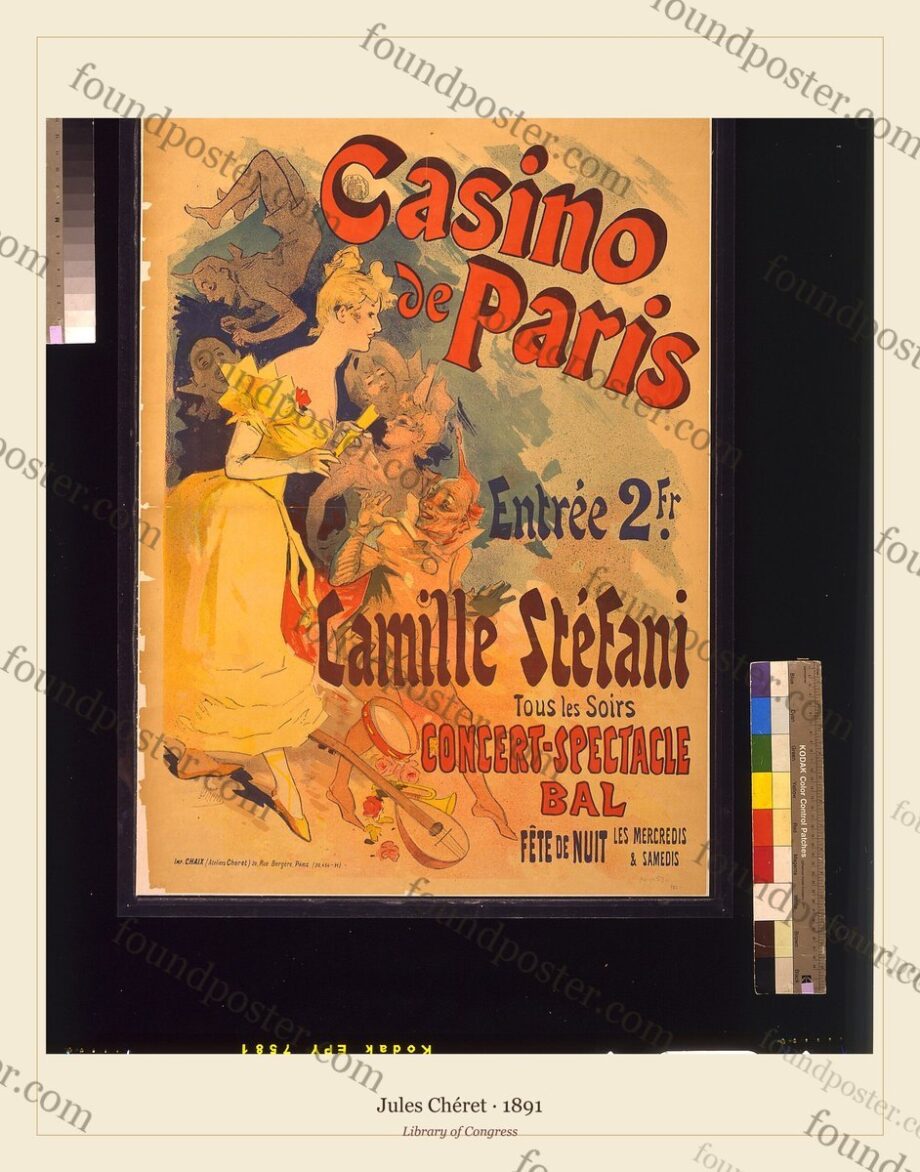
TL;DR — Jules Chéret’s 1891 poster for the Casino de Paris comes from the man who invented the modern colour poster. Two decades before Toulouse-Lautrec, Chéret had turned the Paris street into an open-air gallery of joyful, twirling figures printed in brilliant colour lithography — and had the medium taken seriously enough to earn the Légion d’honneur. This is the story of the ‘father of the poster’ and the music-hall world he advertised.
By Found Poster · Published July 2026
The poster that set the template
By 1891 a Chéret poster was a familiar joy on the boulevards: a whirl of high-spirited figures, usually a laughing woman in mid-movement, printed in a few luminous colours against light space. The Casino de Paris design advertises one of the city’s great music halls, and it does what Chéret did better than anyone — it makes an ordinary evening out look like a celebration.
Where a painting asked to be studied, a Chéret asked only to be enjoyed at a glance, from across a busy street. That was a genuine invention, and everything the Belle Époque poster became was built on it.
Jules Chéret, father of the poster
Jules Chéret (1836–1932) trained as a lithographer in Paris and spent the 1860s in London, where he mastered large-format colour printing. Returning to Paris in 1866, he set up his own press and began producing big, brightly coloured poster designs at a scale and quality the city had never seen.
Over the following decades he made more than a thousand posters and effectively created the profession of the poster artist. In 1890 the French state made him a Chevalier of the Légion d’honneur — official recognition that the poster had become an art form. He is, by common consent, the father of the modern poster.
The Chérette and the three-stone method
Chéret’s signature was the ‘Chérette’ — a laughing, weightless young woman who became a symbol of Parisian pleasure and, in her freedom and gaiety, a small social phenomenon in her own right. She sold theatres, drinks, dances and lamp oil with the same infectious lightness.
His technical method was as important as his imagination. Working with just three or four lithographic stones — typically red, yellow and blue plus a key — he built up a full, glowing range of colour through overprinting and hatching, achieving with a handful of stones what looked like a painter’s palette. It was a masterclass in economy of means.
From the street to the Salon
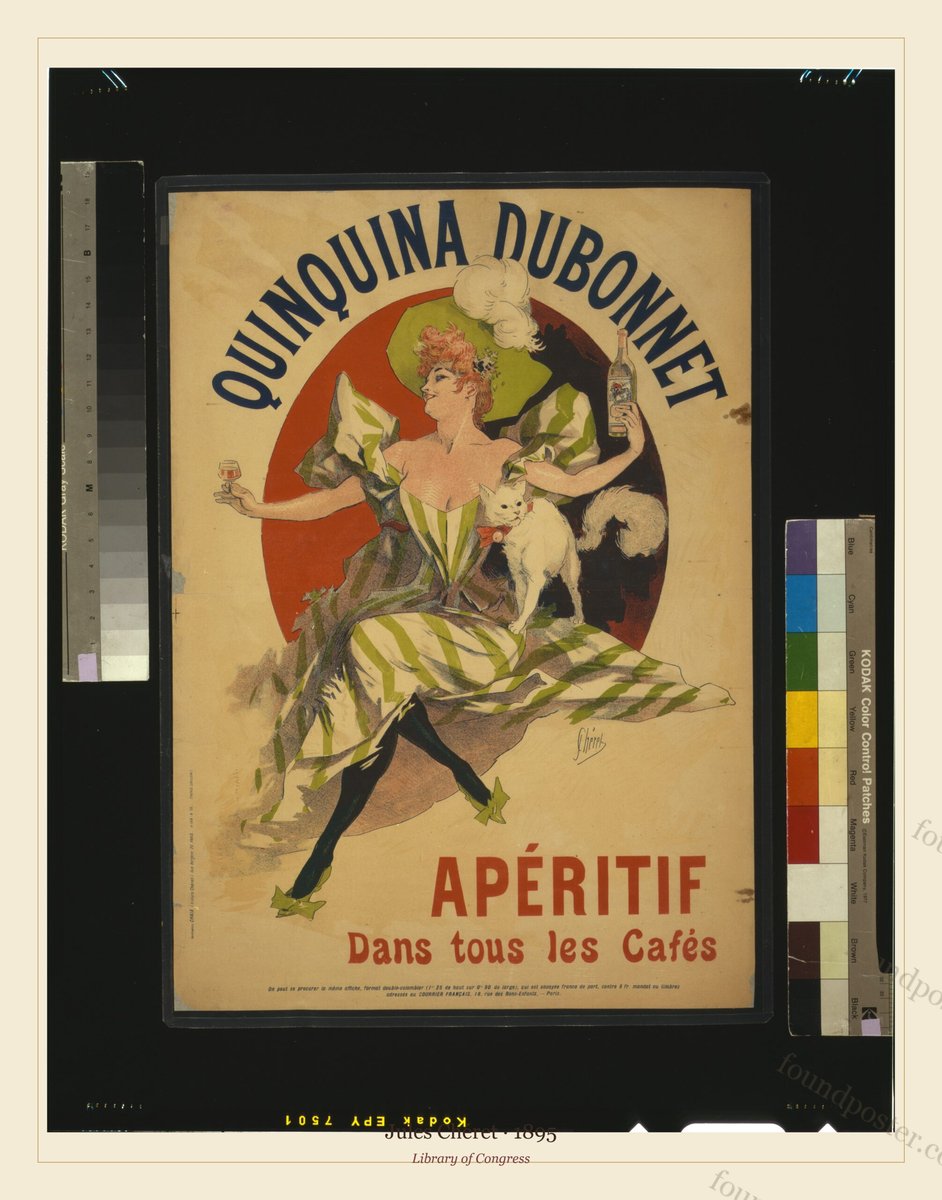
Chéret raised the whole standing of the poster. His work was collected in the artist’s own lifetime, reproduced in de-luxe portfolios for connoisseurs, and cited by the younger artists who followed — most famously Toulouse-Lautrec, whose 1891 Moulin Rouge poster answered Chéret’s example even as it broke with his crowded, decorative manner. Where Chéret gave the boulevard sparkle, Lautrec gave it edge; both begin here. A Casino de Paris poster brings that founding music-hall gaiety to a cocktail bar or bistro wall.
Chéret’s music-hall and apéritif posters are catalogued individually in our archive, restored for printing. Browse Jules Chéret →
Frequently asked questions
Who was Jules Chéret?
Jules Chéret (1836–1932), the French lithographer who created the modern colour poster in the 1860s–1890s and is universally called the ‘father of the poster.’ He made over a thousand designs and was awarded the Légion d’honneur in 1890.
What is a ‘Chérette’?
The laughing, twirling young woman who recurs across Chéret’s posters — a symbol of Parisian gaiety who became a minor social phenomenon and the template for the decorative poster figure.
How did Chéret get such rich colour?
Through skilled overprinting of just three or four lithographic stones — usually red, yellow and blue plus a key drawing — building a full glowing range from a handful of colours.
How does he relate to Toulouse-Lautrec?
Chéret came first and made the medium respectable; Lautrec, twenty years younger, learned from him and then broke with his crowded style in the 1891 Moulin Rouge poster.
Further reading
- Toulouse-Lautrec’s Moulin Rouge — the answer to Chéret
- Who was Jules Chéret? — a fuller survey (scheduled in this series)
- Lautrec vs Chéret: two visions of Paris (scheduled in this series)
- Lucy Broido, The Posters of Jules Chéret (Dover, 1992)
- Alain Weill, The Poster: A Worldwide Survey and History (G.K. Hall, 1985)
Found Poster restores Belle Époque and Art Nouveau posters from museum archives into archival-quality files you print yourself. Browse the archive · How to print & frame.