TL;DR — Will Bradley’s posters for The Chap-Book in 1894–95 are American Art Nouveau at its boldest — sinuous black-and-white ornament advertising a small Chicago literary magazine. Self-taught, steeped in Aubrey Beardsley and the English Arts and Crafts movement, Bradley became the most inventive American graphic designer of his generation and enjoyed one of its longest careers. This is the story of the printer’s apprentice who gave the American ‘little magazine’ its look.
By Found Poster · Published July 2026
The poster and the little magazine
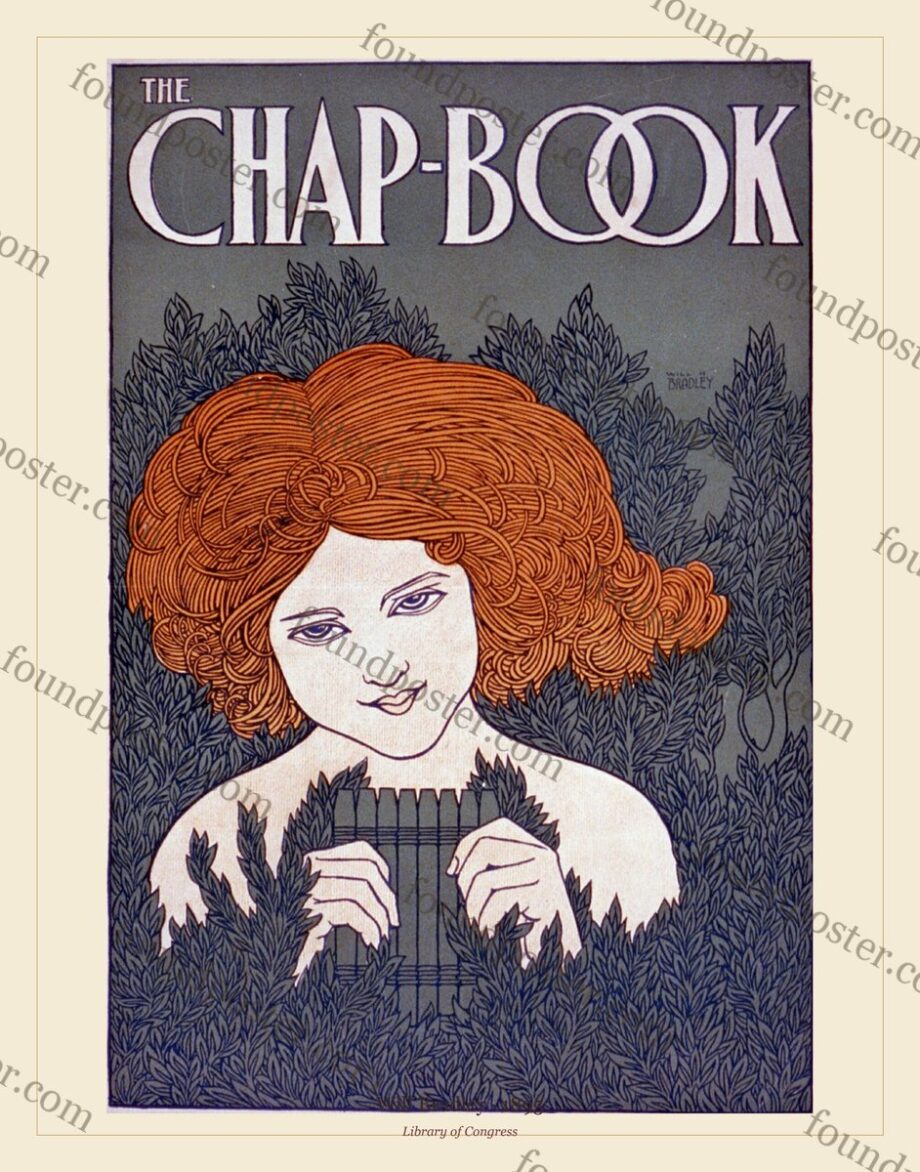
The Chap-Book, launched in Chicago in 1894 by the young publishers Stone & Kimball, is usually called America’s first ‘little magazine’ — a small, literary, design-conscious periodical of the kind that would shape the next century of writing. To sell it on newsstands, the publishers commissioned posters from Will Bradley, and those placards became as celebrated as the magazine itself.
Bradley’s Chap-Book posters reduce the whole image to flat black on cream: hair, drapery and negative space locked into a single ornamental pattern, with barely any tone. The lettering and the figure are designed as one object. You remember the shape long after the words.
Will Bradley: the self-taught printer
Will Bradley (1868–1962) was born in Boston and went to work as a printer’s apprentice — a ‘printer’s devil’ — in Michigan as a boy, after his father died. He never had formal art training. Everything he knew about type, layout and press work he learned at the composing stone, and that press-room fluency is why his designs sit so perfectly as printed objects.
By the mid-1890s he was in Chicago, then the energetic centre of American publishing and design, and his reputation was made almost overnight by the Chap-Book placards.
The American Beardsley
Bradley absorbed the stark black-and-white manner of England’s Aubrey Beardsley and the flat pattern-making of the English Arts and Crafts movement, and turned them to American commercial work — which earned him the nickname ‘the American Beardsley.’ But he was no copyist: his line is sturdier and more architectural than Beardsley’s, built by someone who thought in type and press runs.
Because the work is almost pure graphic design — flat black, flat cream, no fuss — it still reads as contemporary, and it sharpens a modern interior that a busier colour poster would clutter.
The Chap-Book and the little-magazine boom
The Chap-Book set off a wave of American ‘little magazines’ in the 1890s, and the poster became their shared visual signature — a way for a small publication to look like a movement. Bradley sat at the centre of that boom alongside Edward Penfield’s Harper’s covers, the two men defining the American answer to the French poster from opposite temperaments: Penfield calm and Dutch, Bradley ornamental and English.
A long afterlife
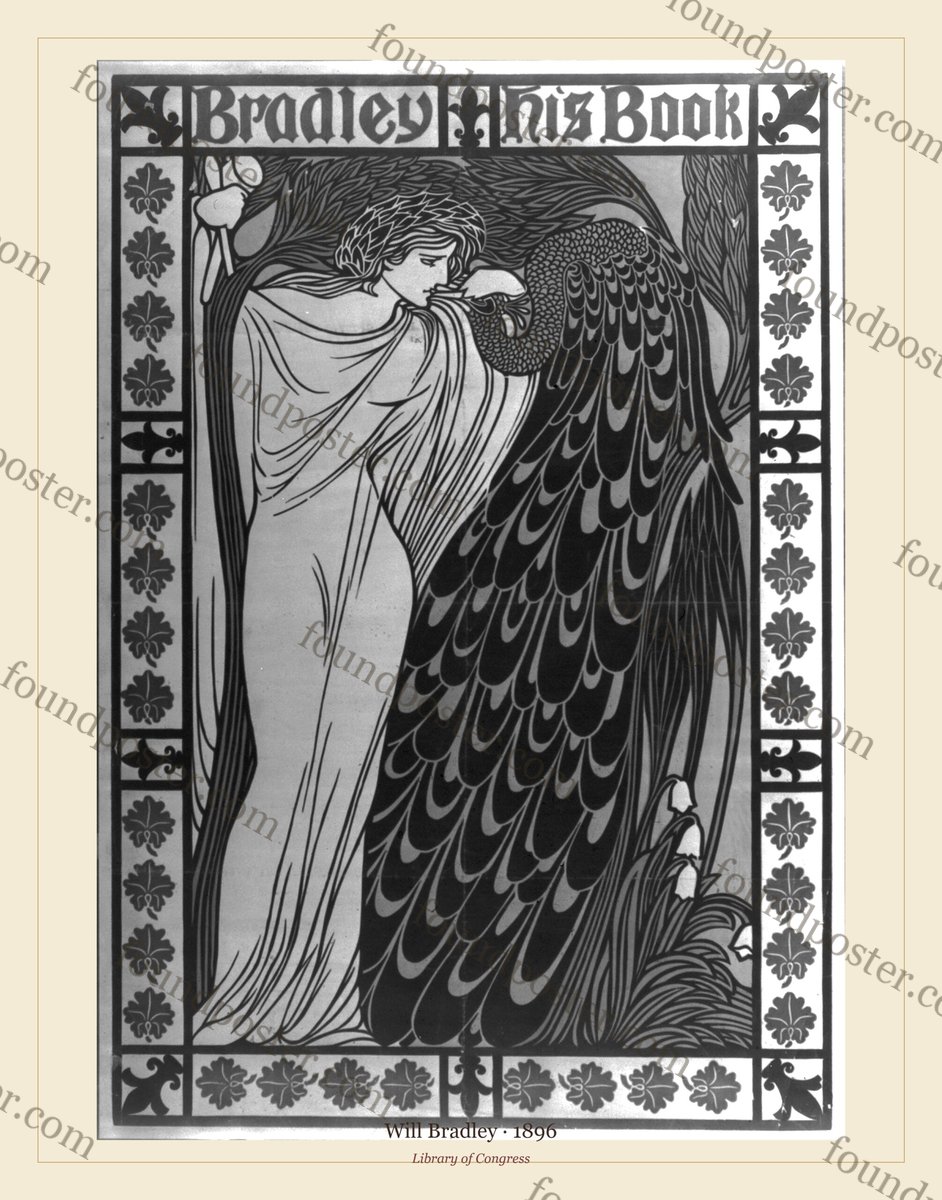
In 1895 Bradley founded his own Wayside Press in Springfield, Massachusetts, where he wrote, designed and printed Bradley: His Book. He went on to a remarkably long career as an art director for Collier’s, the Hearst papers and even early Hollywood, shaping American typography and layout well into the twentieth century. He died in 1962, aged 94 — a working link between the 1890s poster and modern graphic design. In black and cream, a Chap-Book poster suits a specialty coffee bar, a barber shop or a design-led corridor, adding graphic punch without a colour to coordinate.
Bradley’s Chap-Book placards and his own magazine covers are catalogued individually in our archive, restored for printing. Browse Will Bradley →
Frequently asked questions
Who was Will Bradley?
Will Bradley (1868–1962), a self-taught American printer and designer, the leading graphic artist of the 1890s American poster movement, later a long-serving art director. He is often called ‘the American Beardsley.’
What was The Chap-Book?
A small literary magazine launched in Chicago in 1894 by Stone & Kimball, usually called America’s first ‘little magazine.’ Bradley’s posters for it are among the most collected American posters of the decade.
Why is he called the American Beardsley?
Because he worked in the same stark black-and-white decorative manner as England’s Aubrey Beardsley — though with a sturdier, more typographic line of his own.
Does a black-and-white poster suit a colourful room?
Often better than a colour one — a high-contrast graphic piece sharpens a busy interior instead of competing with it.
Further reading
- Edward Penfield — the other pole of the American movement
- Who was Will Bradley? — a fuller survey (scheduled in this series)
- The Chap-Book and the little-magazine poster (scheduled in this series)
- Clarence P. Hornung (ed.), Will Bradley: His Graphic Art (Dover, 1974)
- David W. Kiehl, American Art Posters of the 1890s in the Metropolitan Museum of Art (1987)
Found Poster restores Belle Époque and Art Nouveau posters from museum archives into archival-quality files you print yourself. Browse the archive · How to print & frame.