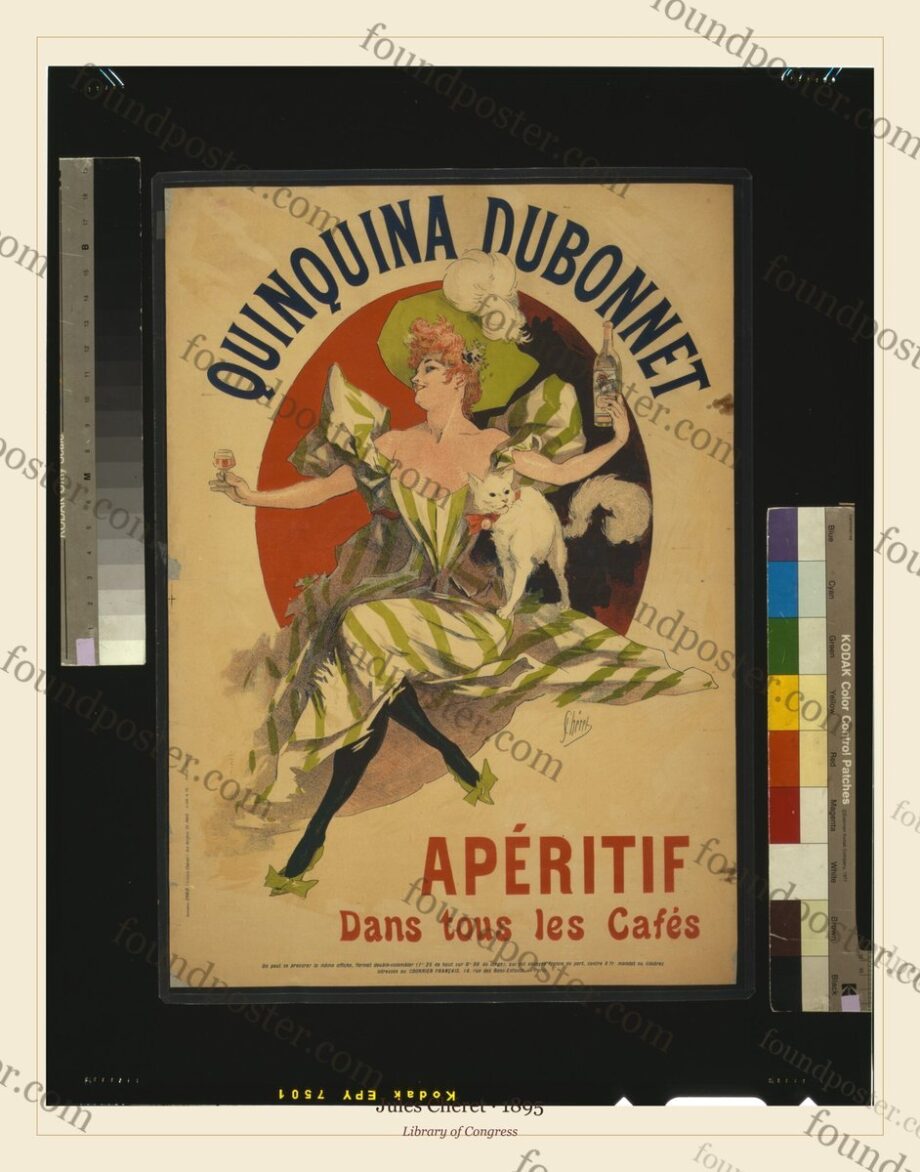
TL;DR — Jules Chéret’s 1895 poster for Quinquina Dubonnet is the father of the poster selling the apéritif that would become a French icon. All of Chéret’s gifts are here — the joyful figure, the glowing three-stone colour, the weightless movement — applied to a drink brand at the dawn of the modern advertising poster. This deep dive looks at the poster, the apéritif, and Chéret’s commercial genius.
By Found Poster · Published October 2026
The poster and the drink
Dubonnet, a quinine-based apéritif created in 1846, became one of the defining French drinks of the Belle Époque, and Chéret gave it one of its earliest great posters. His design sells not a product but a mood — a laughing figure in glowing colour, the very picture of the pleasure the drink promised. It is advertising as celebration, which was Chéret’s enduring formula.
Chéret the commercial genius
Chéret invented the modern colour poster and made it respectable, but he was also a supremely effective adman. He understood that a poster sells feeling, and his joyful ‘Chérettes’ attached that feeling to everything from lamp oil to apéritifs. Dubonnet is a perfect case: the drink and the gaiety become one image.
For the full story of Chéret’s career and his invention of the poster, see the deep dive on his Casino de Paris design; here the interest is his command of the drinks advertisement.
The three-stone glow, applied to a brand
The Dubonnet poster shows Chéret’s technical signature at full strength: a complete, luminous range of colour built from just three or four lithographic stones, giving the sheet its characteristic warm glow. That glow is why a Chéret still lifts a wall — it carries the light of the gas-lit boulevard it was made for.
Where it belongs
An apéritif poster by the father of the poster is made for a bar, a bistro or a wine room. It names the pleasures of the French table in the most joyful visual language the poster ever produced, and it connects a modern room directly to the Belle Époque origins of the apéritif hour.
Chéret’s apéritif and music-hall posters are catalogued individually in our archive, restored for printing. Browse Jules Chéret →
Frequently asked questions
What is Quinquina Dubonnet?
Dubonnet, a quinine-based French apéritif created in 1846, became a Belle Époque icon; Chéret designed one of its earliest great posters in 1895.
Who was Jules Chéret?
The father of the modern colour poster — see the deep dive on his Casino de Paris poster for the full account of his career and method.
Why do his posters glow?
Chéret built a full luminous colour range from just three or four lithographic stones, giving his sheets a characteristic warm glow.
Further reading
- Chéret’s Casino de Paris — the fuller account
- Posters for a French bistro
- Lucy Broido, The Posters of Jules Chéret (Dover, 1992)
Found Poster restores Belle Époque and Art Nouveau posters from museum archives into archival-quality files you print yourself. Browse the archive · How to print & frame.